

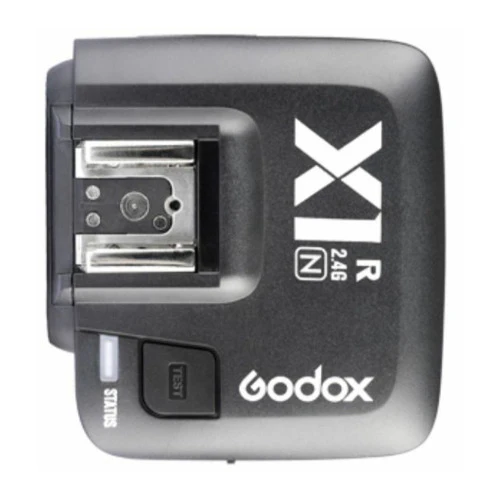
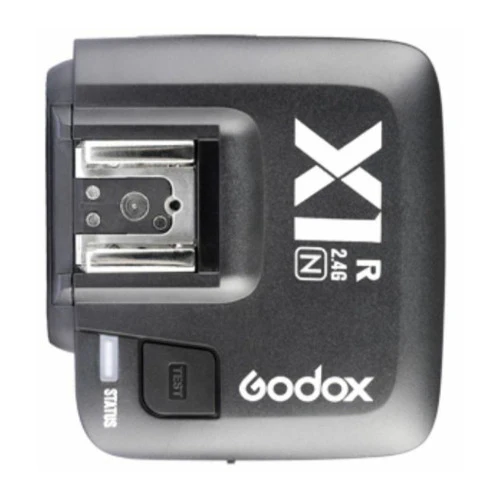
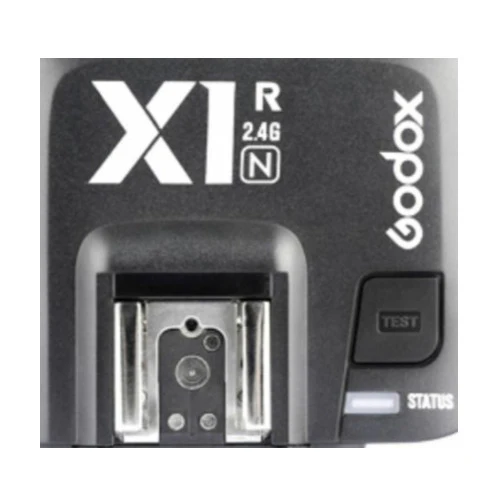
Godox X1R-N TTL Wireless Flash Trigger Receiver For Nikon
Godox's first TTL wireless flash trigger applies to Nikon DSLR series cameras. Featuring multi-channel triggering, stable signal transmission, and the sensitive reaction it can be used to trigger camera shutter, studio flash, and camera flash. This trigger receiver unit is compatible with Nikon cameras that support i-TTL.
Built-in 2.4G Wireless Transmissions
Built-in 2.4G wireless transmission provides 100 further transmission distances and creative triggering methods.
Fully Supporting TTL Functions
It supports i-TTL autoflash, 1/8000s High-speed Sync, Flash Exposure Compensation, Flash Exposure Lock, Modeling Flash, etc.
Wireless Remote Control and Grouping System
It comes with GR group flash and wireless grouping (max. 4 groups and 32 channels) and triggering the flash.
Big and Clear LCD Panel
This receiver features a backlight LCD panel to offer convenient operation.
More Functions
The receiver does versatile functions such as synchronization delay setting, wireless shutter release, zoom setting, and more. PC sync socket to input and output; the receiver uses a 2.5mm sync cable to output.
Memory Functions
It also features a memory function that will store settings 2 seconds after the last operation and recover after a restart.
USB
USB firmware upgrades help keep pace with the latest technology.
Original: $40.00
-65%$40.00
$14.00More Images



Godox X1R-N TTL Wireless Flash Trigger Receiver For Nikon
Godox's first TTL wireless flash trigger applies to Nikon DSLR series cameras. Featuring multi-channel triggering, stable signal transmission, and the sensitive reaction it can be used to trigger camera shutter, studio flash, and camera flash. This trigger receiver unit is compatible with Nikon cameras that support i-TTL.
Built-in 2.4G Wireless Transmissions
Built-in 2.4G wireless transmission provides 100 further transmission distances and creative triggering methods.
Fully Supporting TTL Functions
It supports i-TTL autoflash, 1/8000s High-speed Sync, Flash Exposure Compensation, Flash Exposure Lock, Modeling Flash, etc.
Wireless Remote Control and Grouping System
It comes with GR group flash and wireless grouping (max. 4 groups and 32 channels) and triggering the flash.
Big and Clear LCD Panel
This receiver features a backlight LCD panel to offer convenient operation.
More Functions
The receiver does versatile functions such as synchronization delay setting, wireless shutter release, zoom setting, and more. PC sync socket to input and output; the receiver uses a 2.5mm sync cable to output.
Memory Functions
It also features a memory function that will store settings 2 seconds after the last operation and recover after a restart.
USB
USB firmware upgrades help keep pace with the latest technology.
Product Information
Product Information
Shipping & Returns
Shipping & Returns
Description
Godox's first TTL wireless flash trigger applies to Nikon DSLR series cameras. Featuring multi-channel triggering, stable signal transmission, and the sensitive reaction it can be used to trigger camera shutter, studio flash, and camera flash. This trigger receiver unit is compatible with Nikon cameras that support i-TTL.
Built-in 2.4G Wireless Transmissions
Built-in 2.4G wireless transmission provides 100 further transmission distances and creative triggering methods.
Fully Supporting TTL Functions
It supports i-TTL autoflash, 1/8000s High-speed Sync, Flash Exposure Compensation, Flash Exposure Lock, Modeling Flash, etc.
Wireless Remote Control and Grouping System
It comes with GR group flash and wireless grouping (max. 4 groups and 32 channels) and triggering the flash.
Big and Clear LCD Panel
This receiver features a backlight LCD panel to offer convenient operation.
More Functions
The receiver does versatile functions such as synchronization delay setting, wireless shutter release, zoom setting, and more. PC sync socket to input and output; the receiver uses a 2.5mm sync cable to output.
Memory Functions
It also features a memory function that will store settings 2 seconds after the last operation and recover after a restart.
USB
USB firmware upgrades help keep pace with the latest technology.


